How a Weddell Seal Dive Fits Into an Oxygen Budget
A dive is a managed supply of oxygen and a route back to air, not just a maximum-depth record.
The clock begins with stored oxygen
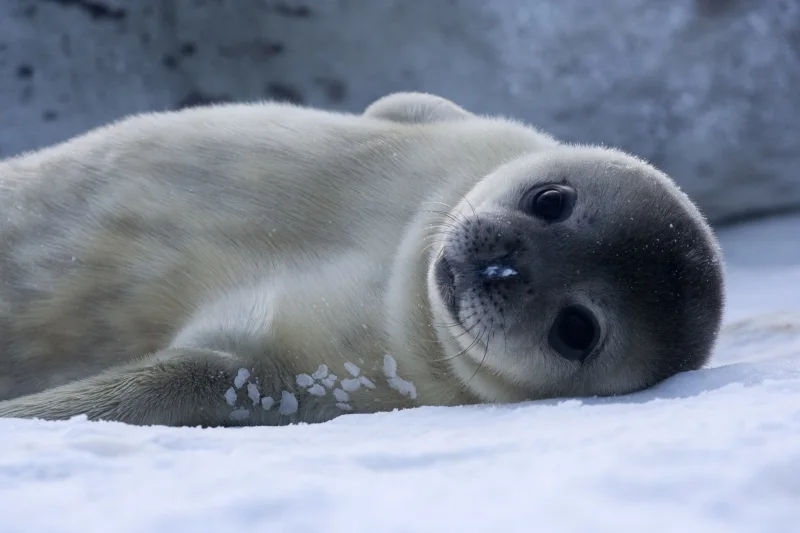
A Weddell seal must return to air, even while it feeds beneath Antarctic ice. Its dive depends on oxygen carried in its lungs, blood and muscles and on how that supply is used. Diving adaptations are best understood as parts of a budget rather than as a list of exceptional maximums.
A maximum recorded depth does not describe a typical feeding dive. Depth, duration, activity and the animal's condition all contribute to the physiological demand. Reporting one record without the accompanying context can turn an adaptation story into a misleading expectation.
The ice is both habitat and barrier
Fast ice can provide a stable surface for resting and breeding, but a seal beneath it still needs access to breathing openings. A route through the water is therefore connected to the distribution of accessible air. That makes a map of the surface alone an incomplete description of the seal's habitat.
The Australian Antarctic Program describes Weddell seals as strongly associated with coastal fast ice. This habitat context is more useful to a general reader than assuming that every seal seen in Antarctica has identical diving behavior or ice use.
How to read a tag study
Check whether a device measures depth, movement, location or environmental conditions. An instrument can document a dive profile without showing every prey capture. Researchers may infer feeding behavior from patterns, but an inference should be labeled and supported rather than described as direct observation.
Also ask how many seals were studied and in which season. A small set of tagged animals can provide valuable observations while remaining an incomplete sample of the population. Our companion under-ice observation guide concerns what an image reveals; this article concerns the physiological and habitat constraints behind the movement.
Read a dive profile before reading the record
A dive profile normally places elapsed time along one axis and depth along the other. Before interpreting its shape, check which direction represents deeper water and whether the scale changes between panels. A steep line may indicate rapid vertical movement, but its visual steepness also depends on the plotting dimensions. Two identical dives can look different when one chart is stretched. Comparing the numbers prevents a design choice from becoming an apparent biological difference.
Then divide the profile into descent, time at depth and ascent. This descriptive exercise does not assign a purpose to every movement. A relatively level segment might be consistent with an activity of interest, but depth alone cannot identify the animal's target or count successful captures. When an article calls a segment feeding, look for the additional observations or validated method supporting that interpretation. Otherwise, describe the measured movement and leave its precise purpose open.
Connect the official breathing-hole account to a dive profile
The Australian Antarctic Program describes Weddell seals maintaining openings by rasping new ice with their teeth. That observation gives the oxygen-budget story a physical destination: the animal must reconnect with accessible air. A maximum-depth headline omits this spatial requirement. Draw an opening above the end of a conceptual dive profile to show why return access belongs in the explanation alongside stored oxygen.
The same source describes wear associated with maintaining openings. This is a concrete example of a capability with costs, rather than an unlimited superpower. It does not let us calculate the cost of a particular photographed dive or assign a safe duration. For reading research, identify the depth and timing measurements, then ask what information describes the openings and route. Physiology and habitat together explain the constraint more clearly than a record number alone.
Fast ice is not the same as an unbroken ceiling
The word fast describes ice attached to the coast or another fixed feature; it does not mean ice moving quickly. For a seal, the distribution of openings and usable access to air gives the underwater environment a structure that a white surface photograph can conceal. An image of continuous-looking ice should not be treated as proof that no breathing opportunity exists beyond the frame.
Equally, seeing one opening does not reveal all the routes an animal uses. A useful habitat account connects the visible surface with observations of the animal's movement. It should identify whether a route was actually measured, inferred from repeated appearances or included simply as an illustration. This distinction helps explain why animals associated with the same broad ice category may still encounter different local conditions.
What a small instrument sample can contribute
Suppose a fictional study records several animals during one deployment season. Repeated profiles can reveal variation among those individuals and provide information unavailable from occasional surface sightings. That is valuable even when the sample is small. The limitation is not that the observations become meaningless; it is that the study's coverage should remain attached to the conclusions drawn from them.
Check whether the report describes every recorded dive, a selected group or only the most extreme example. A maximum selected from many observations answers a different question from the median or the distribution. Also distinguish instrument failure from an animal's disappearance. If recording stops, the last position marks the end of the available record, not automatically the end of the animal's movement or survival.
An evidence summary you can actually use
After reading a dive story, write down the species, location, season, number of animals, instrument measurements and main conclusion. Beside the conclusion, note whether it describes a direct measurement or a behavioral interpretation. This compact record makes two studies easier to compare and exposes missing context before a dramatic number is repeated.
The practical result is a fuller understanding of the animal: a Weddell seal uses an oxygen supply while moving through habitat that includes both water and access to air. Records illustrate what has been observed. They do not replace the budget, the route or the sampling information needed to understand how that observation fits the seal's life.
Compare two fictional profiles
Imagine two dives reaching the same depth. One returns soon after arriving; the other includes a longer interval at depth. The shared maximum cannot establish equal duration, equal activity or equal oxygen use. Now imagine the charts use different vertical scales. Even their apparent shapes become difficult to compare until the axes are aligned.
The exercise gives a reader a concrete order of operations: inspect the axes, identify the measured variables, compare the full profiles and only then consider a biological explanation. None of those steps requires inventing a maximum that the source did not report.