A Polar Bear Is Built for Hunting on Ice, Not Just Enduring Cold
Connect insulation, movement and feeding ecology without treating every Arctic adaptation as the same solution.
Insulation solves only part of the problem
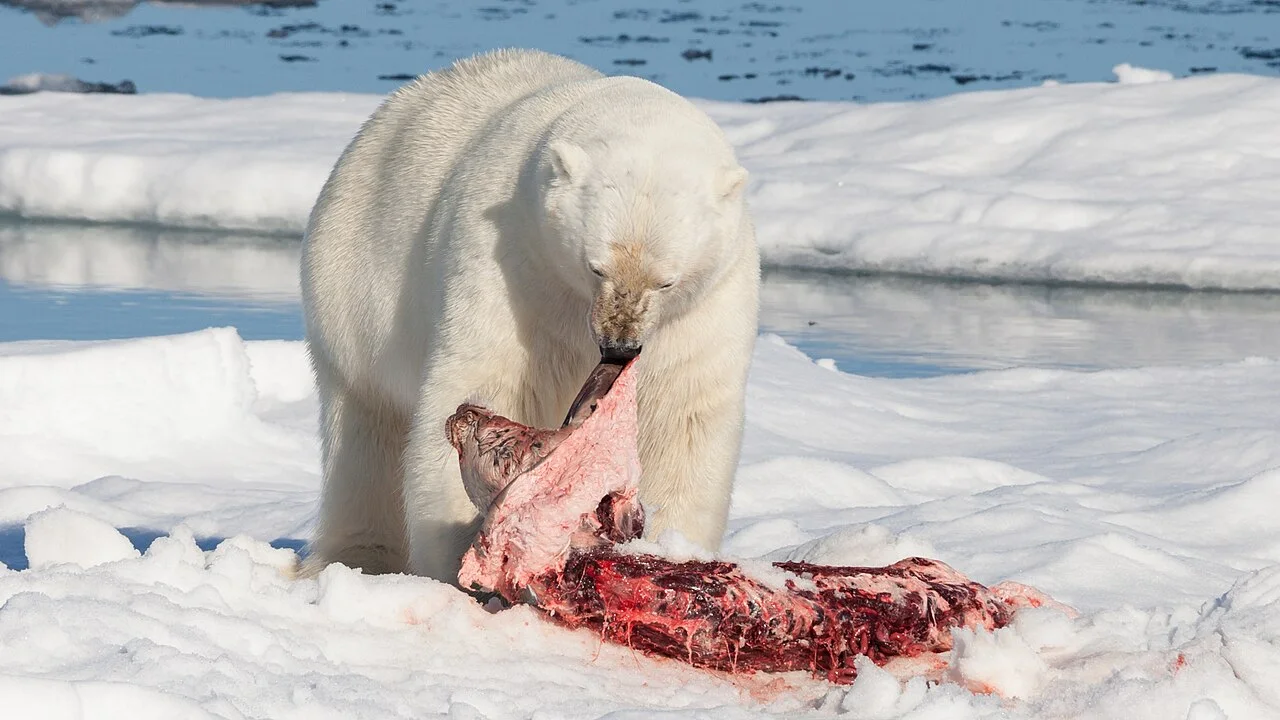
A polar bear's dense fur and fat help limit heat loss, but surviving cold is not its whole ecological task. It must also find energy-rich prey across a changing marine landscape. Sea ice provides access to seals; a bear on land may be well insulated while having fewer opportunities to obtain the food needed to maintain its body condition.
This distinction explains why a photograph of a healthy-looking bear cannot establish that its habitat is secure. Appearance at one moment, seasonal access to prey and long-term population performance are different kinds of evidence.
Match the adaptation to the job
Large paws spread load and assist movement through snow and water. Smell helps locate opportunities that are not obvious to a human observer. These traits work together with behavior: searching, waiting and adjusting movements to local conditions. It is more informative to connect each feature to a task than to describe the animal as perfectly adapted to an unchanging Arctic.
The word perfect is especially unhelpful when conditions change. An adaptation that works within one range of ice and prey conditions does not remove energetic costs or guarantee that a population can absorb every change in its environment.
Read individuals and populations separately
A swimming bear demonstrates an ability, not an unlimited endurance budget. An animal feeding on land demonstrates dietary flexibility, not proof that terrestrial foods can replace marine feeding for an entire population. Avoid drawing either conclusion from a memorable video.
For conservation interpretation, combine species biology with regional survey evidence. Identify which population is being discussed, the observation period and the measure used. This article explains the biological connections; our Western Hudson Bay guide separately explains how to interpret a dated abundance estimate.
Connect the body plan to a feeding opportunity
A bear's heat-conserving features are useful only within an energy budget that also includes food acquisition. Imagine an animal spending time searching for prey, waiting near an opportunity and moving between feeding areas. Each activity has a cost, while a successful feeding event provides an uneven return. Insulation reduces some losses, but it does not create food or make the cost of traveling between opportunities disappear.
This is a more useful framework than calling a bear perfectly engineered for cold. The animal is adapted to a set of environmental opportunities and constraints. If access to prey changes, anatomical features can remain impressive while the balance between expenditure and intake becomes more difficult. The mechanism links habitat to the animal without implying that every bear responds identically or that a single observation reveals its entire condition.
Why a swimming video cannot settle a habitat argument
A video can establish that a particular bear swam during the recorded interval. It may also document a remarkable physical capability. What it does not show automatically is the animal's prior condition, the distance still to travel, its later feeding success or the consequences over a season. A capability should not be rewritten as an unlimited resource simply because the visible performance is impressive.
The same caution applies to land-based feeding. An animal eating an available food has demonstrated use of that food. To assess whether the resource can replace marine feeding for a regional population, researchers need information about its energy value, availability, access and the animals' requirements. These are larger questions than whether an individual can swallow it. Distinguishing them lets readers appreciate behavioral flexibility without treating every example as proof that habitat change has no cost.
Use the official species account to explain a bear on land
The U.S. Fish and Wildlife Service profile places polar bears in a marine feeding system connected to sea ice. Use that relationship to answer a common photograph question: why can an insulated bear still face a habitat problem? Start with what fur does, reducing heat loss, and then identify what the feeding habitat supplies. These are different sides of the same energy budget, so strength in one does not compensate automatically for a shortage in the other.
For an animal photographed ashore, the defensible description is its observed location and activity. To explain the wider significance, add the seasonal feeding context from the species account. Do not diagnose its condition from location alone. This gives the reader an actual mechanism connecting ice and food, instead of an unsupported conclusion that either a land sighting proves adaptation or every land sighting proves starvation.
Choose observations that can answer the question
For a question about hunting behavior, direct observations or appropriate tracking and activity data may be relevant. For a question about body condition, measurements suited to that purpose are needed. For a question about regional abundance, use a defined survey. A photograph can illustrate the species while remaining insufficient evidence for any of those broader conclusions on its own.
A useful reading exercise is to label each statement in an account as anatomy, behavior, condition, habitat or population. Then ask what connects the categories. A paragraph may move from a real anatomical fact to an unsupported population conclusion without warning. Naming the steps exposes that gap and suggests what further evidence would help. The exercise makes biology practical for readers evaluating conservation stories rather than leaving them with a list of disconnected animal facts.
A responsible comparison with other bears
Comparisons with terrestrial bears can illuminate differences in feeding ecology, but they need a defined question. The fact that another bear species eats a varied land-based diet does not establish the nutritional feasibility of the same strategy for polar bears in a particular place. The comparison must account for what foods exist, when they are available and how they relate to the animals' needs.
After reading, the central takeaway should be a connection: cold tolerance supports survival, but access to energy-rich prey helps determine how that survival is sustained. This page explains the connection, while the separate Hudson Bay article explains how surveys assess one population. Keeping the two tasks distinct gives readers both a biological mechanism and a way to evaluate the evidence used to describe its consequences.
A practical way to compare two wildlife accounts
Choose one account describing an individual and another reporting a regional survey. Write the question each answers before comparing their conclusions. If their questions differ, they may complement one another rather than conflict. This prevents an appealing individual story from replacing population evidence, while also preventing a population statistic from erasing the value of a carefully documented observation.