Arctic Foxes: Insulation, Food Caches and a Variable Coat
A small predator survives through several interacting strategies, not a universal white winter coat.
Small ears are part of a heat budget
The Arctic fox's compact form and dense fur help conserve heat. That is an anatomical response to cold, but it does not eliminate the need to find food. A small animal must manage both the energy it loses and the energy it can acquire.
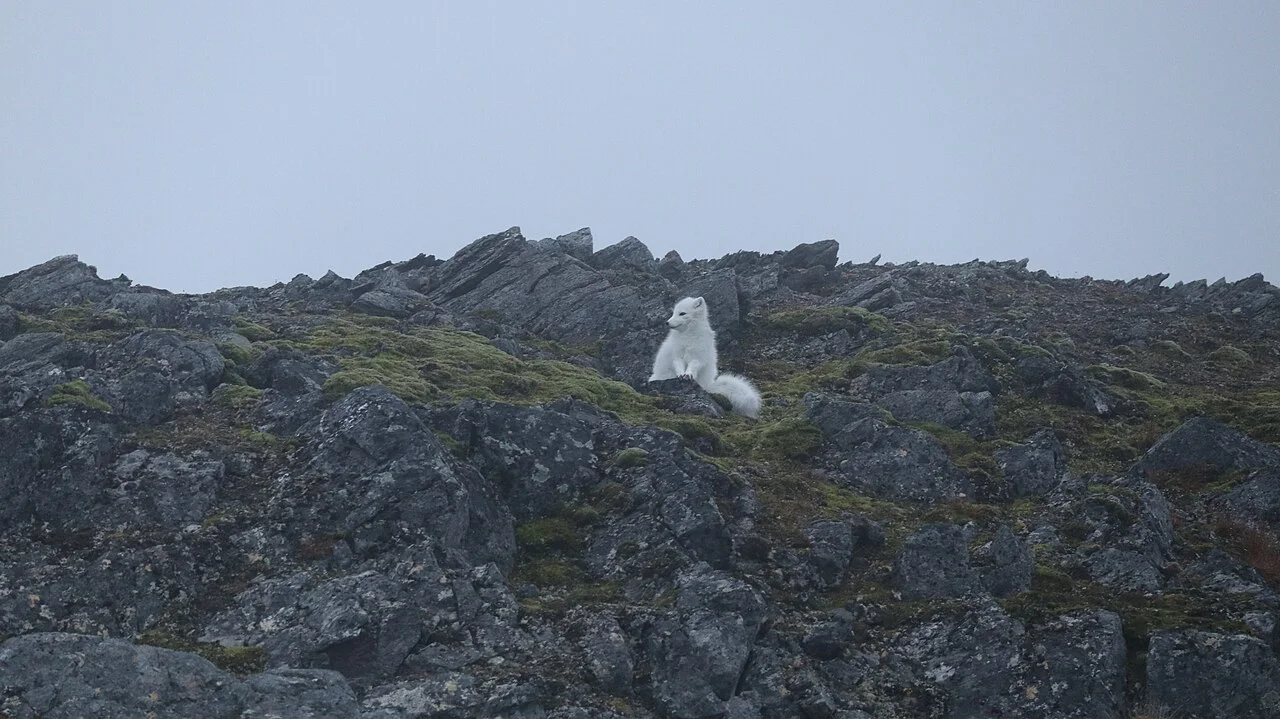
Describing it only as a white fox misses important variation. Coat color depends on the animal's color form as well as the season. Not every individual becomes the same bright white, and color is not a reliable stand-alone guide to population, health or habitat quality.
An opportunist with a storage strategy
Arctic foxes use a range of foods, including small mammals and scavenged material. Local prey availability can be highly variable. Caching food moves some feeding opportunity from a moment of abundance into a later period when fresh food is harder to obtain.
This is a different mechanism from insulation. Fur reduces a cost; a cache helps spread food availability through time. Treating both as parts of one budget makes the animal's flexibility easier to understand without suggesting that flexibility removes ecological constraints.
What to notice in an observation
Record the location, date, visible coat and behavior rather than assuming that a single individual represents all Arctic foxes. A fox beside a settlement may be responding to a food source specific to that place. Its presence is not a reason to feed it or approach a den.
For interpreting a wider claim, ask whether it concerns diet, breeding, geographic range or abundance. Evidence about one does not automatically establish another. The Alaska Department of Fish and Game profile is a useful biological starting point; local wildlife rules and current conservation assessments require their own place-specific checks.
Turn a list of traits into an energy explanation
Imagine a fox facing a period when fresh prey is difficult to find. Dense insulation can reduce the energy needed to maintain its body, while stored food may provide access to energy acquired earlier. These are complementary responses on opposite sides of a budget. One reduces a cost; the other helps manage the timing of supply. Neither makes a period of scarcity irrelevant.
This framework explains why diet, movement and insulation belong in the same article. A description focused only on fur can make the animal seem independent of its food web. A description focused only on hunting can miss the value of conserving energy. Connecting them gives readers a way to understand how a small predator functions in a variable environment without implying that every fox encounters the same conditions.
A coat is not a complete identification record
Photographs of Arctic foxes can show different colors and seasonal appearances. Before interpreting a difference as an environmental response, check the date, location and the animal's color form. An image's lighting, exposure and processing may also affect its appearance. Color can be useful descriptive information, but it should not carry a conclusion about health, age or population history without appropriate support.
A good observation note therefore begins with what is visible and known. State the coat appearance, behavior and setting; preserve any uncertainty about the date or individual. Do not turn an unfamiliar-looking fox into a newly discovered adaptation merely because it differs from a familiar stock image. Variation within a species is often more informative than a simplified picture of one standard winter animal.
Caching makes time part of the food problem
A food cache changes when a resource can be used. Its importance is therefore not captured by a photograph of the current hunting conditions alone. A fox may have acquired food earlier, and the availability of a stored resource can differ from the availability of live prey at the moment an observer arrives. The behavior connects periods of opportunity and scarcity.
That connection should not be exaggerated into a guarantee. The existence of caching does not show that every animal has an adequate store or that the store remains accessible. To evaluate a study, ask what researchers observed about the location, use or outcome of caches. A description of a possible strategy and evidence of how much it contributes are different stages of understanding.
Avoid confusing human food with ecological flexibility
A fox attracted to a settlement or visitor area may be responding to an opportunity created by people. That observation does not demonstrate that feeding wildlife is helpful, nor does it establish a healthy long-term relationship. Local wildlife guidance should determine how observers behave. A close photograph is not a good enough reason to offer food or approach a den.
From an analytical perspective, record the human setting as part of the observation rather than cropping it out of the explanation. A fox near refuse, a fox searching open tundra and a fox beside a nesting area face different immediate opportunities. Treating them as identical examples of natural hunting behavior can conceal the very factor that explains why the animal was present.
Read a population claim beyond a single encounter
An encounter tells you that an animal was observed under particular circumstances. A population claim concerns a broader pattern and needs a suitable sampling framework. Repeated records can be useful, but changes in observer effort and access also affect how many encounters are reported. More photographs online do not automatically establish more foxes.
When reading a broader account, identify whether its main evidence concerns food availability, reproduction, distribution or abundance. Ask how the study connects those observations to its conclusion. The Alaska profile provides biological context; a particular regional trend requires additional local evidence. The practical result is a more useful picture of adaptation: a flexible animal with several interacting strategies, still dependent on real resources and a specific environment.
Resolve the dark-winter-fox puzzle with Alaska's profile
The Alaska Department of Fish and Game account describes both blue and white color phases. This resolves a practical identification puzzle: a winter photograph of a dark fox need not contradict a textbook picture of a white Arctic fox. First identify the species using appropriate features, then read the color-form description. Season alone is insufficient to predict the same coat for every individual.
The account also discusses seasonal molt. Use those descriptions as context for the populations covered, rather than assigning one exact changeover date to every location. For a comparison sheet, label species, place, date and visible coat separately. Leave an individual's color form uncertain when the image cannot establish it. This produces a useful explanation of variation without making claims about an animal's health or climate response based solely on a surprising color.