Polar Night Does Not Mean Identical Darkness All Day
Use solar elevation and twilight to understand winter photographs of Longyearbyen.
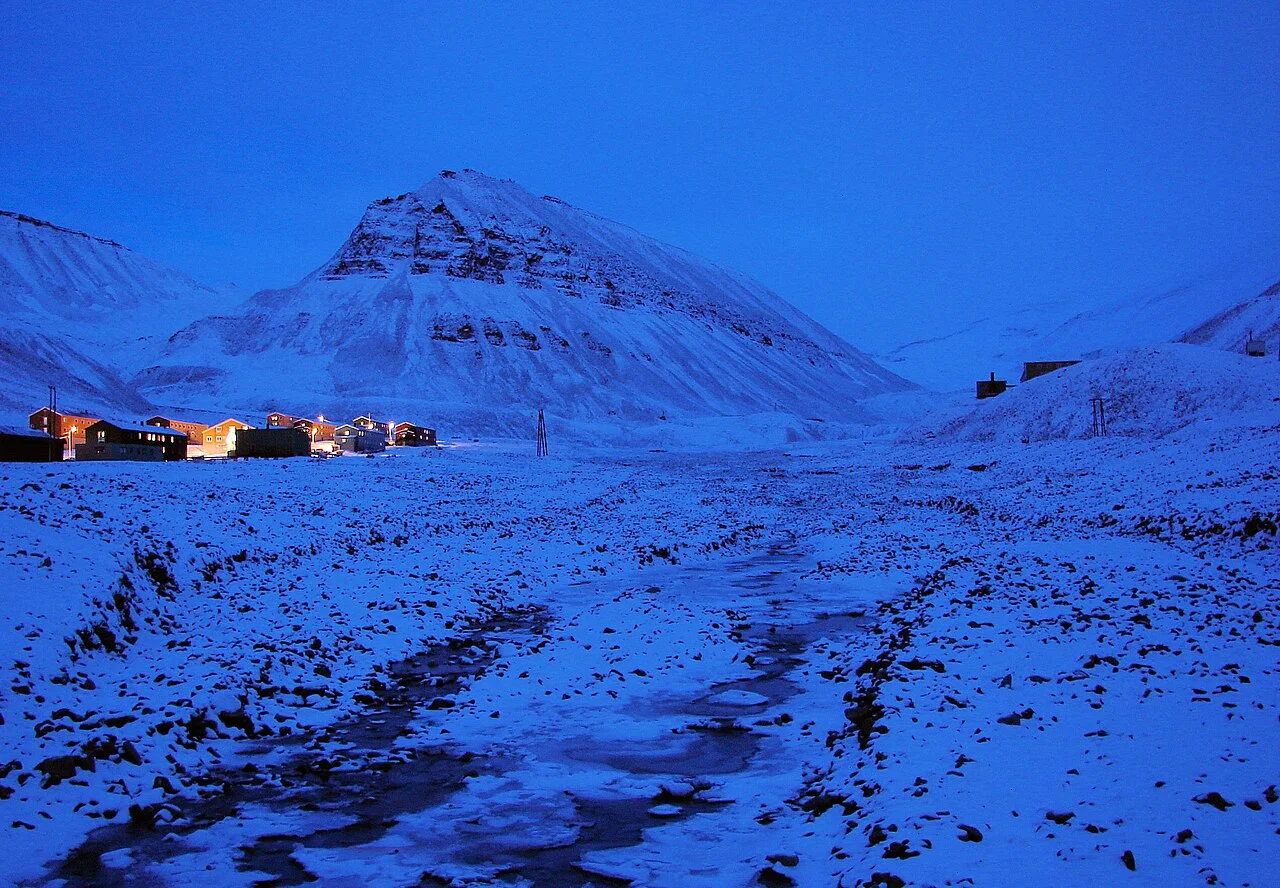
The Sun's position is the starting point
Polar night means that the Sun does not rise above the horizon during the relevant daily cycle. It does not mean that every hour has identical illumination. Twilight can occur when the Sun remains below the horizon, and the available light varies with latitude, date, weather and local terrain.
That distinction helps explain why photographs of a polar-night town can range from blue twilight to a dark sky. They need not contradict one another; they may record different solar elevations and conditions.
A photograph has another light budget
Moonlight, reflected snow and artificial lighting can influence what a camera records. Exposure and processing can make a dim scene look brighter than an observer recalls. A town's lights can also create a local appearance that does not represent the surrounding unlit landscape.
For a caption, record the place, date and time when known. If precise times are missing, avoid claiming that a frame demonstrates the same conditions for the entire season.
Read the solar table before repeating a duration
A location-specific solar table distinguishes sunrise, sunset and different twilight intervals. A broad phrase such as four months of darkness can hide those distinctions and local horizon effects. Use the exact definitions relevant to the claim rather than turning a tourism slogan into an astronomical constant.
This article offers an observation framework, not a diary of living in Longyearbyen or a current weather report. The credited town photograph is a reference image. For travel or outdoor activity, consult current local guidance; a bright photograph does not establish safe visibility, access or conditions on a particular route.
The horizon definition and the local skyline differ
A solar table uses specified astronomical conventions, while hills and buildings can obstruct a person's actual view. A calculated sunrise and the first direct sunlight reaching a particular street therefore need not describe exactly the same experience. Before comparing a local account with a table, identify which horizon or visibility question each addresses.
This does not make the calculation or the experience wrong. It means the terms need to remain attached to their definitions. A town photograph can document a visible scene while a solar table describes the Sun's calculated position for a location and date. Using them together is informative when the article explains their distinct roles instead of forcing one to replace the other.
Twilight has categories rather than one brightness
Solar tables commonly distinguish civil, nautical and astronomical twilight using the Sun's position below the horizon. Read the source's definitions rather than treating the category names as promises of a particular photographic appearance. Cloud, terrain and local light still affect what a person or camera records. The astronomical classification is a framework, not a complete brightness measurement of every street.
For a practical reading exercise, choose a date and follow the table's labeled intervals. Note whether sunrise occurs and which twilight categories appear. Keep the location and year with the result. This answers a more precise question than how many months are dark and avoids converting an appealing travel phrase into an exact description of every hour.
Read a specific Longyearbyen row instead of a darkness slogan
For November 4, 2026, the Longyearbyen solar table reports no sunrise while listing civil twilight from 09:10 to 14:09 in the table's local-time convention. That is a concrete answer to how a polar-night scene can still contain daylight-like sky brightness. The absence of sunrise and the presence of twilight describe different solar thresholds, so these entries are compatible.
Use the row as an astronomical example, not a weather forecast or an exact brightness prediction for every street. Local terrain, cloud and artificial light affect the visible scene, while exposure affects the displayed photograph. When comparing a town image with the table, retain the image's actual date and time if known; do not assign November's example to an undated frame. The useful procedure is to read the sunrise status first, the twilight intervals second and the photographic conditions separately.
Town lights describe a local environment
Artificial illumination can dominate a foreground while leaving the sky and surrounding landscape much darker. Snow and other surfaces affect the appearance of that light in the scene. A brightly rendered street therefore should not be described as the natural illumination of the whole region. The camera combines the sources visible from its particular position.
An informative caption can distinguish town lighting, visible sky glow and known moonlight without claiming an exact contribution from each. If the exposure or processing is unknown, avoid assigning calibrated brightness. The visual contrast between a lit settlement and its surroundings can still be described accurately. It is an observation of the frame, not a measurement of all-day conditions across the season.
Exposure changes a darkness comparison
A long exposure can collect light that a viewer would not perceive with the same brightness in a moment. If two photographs use different exposures or processing, their displayed brightness is not a direct comparison of ambient conditions. This is especially relevant for polar-night imagery, where an appealing bright scene can be mistaken for a statement about ordinary visual experience.
To compare conditions, seek consistent recording information or an appropriate measurement source. For artistic interpretation, describe the displayed scene without pretending it is a calibrated instrument. Both purposes are legitimate. Keeping them separate lets a publication show an evocative photograph while avoiding an unsupported claim that the entire season always looked as bright as the screen image.
Build a caption with an astronomical anchor
Use the place, date and known time as the anchor. Add the relevant solar-table interpretation only when those details support it. Then describe visible light sources and disclose available recording information. If an image is merely illustrative, say so and avoid assigning it a precise twilight state. The caption becomes more useful by explaining the evidence rather than adding an exact number without a basis.
The reader's takeaway is that polar night describes the Sun's relationship to the horizon, while a town's appearance involves several additional influences. That distinction explains why blue twilight, a dark sky and bright streets can all appear in honest winter photographs. It replaces a misleading picture of identical continuous darkness with a framework that can be checked against location-specific solar information.
Nearby places can have different horizon settings and solar details. Preserve the named location rather than borrowing a convenient duration from a general regional description. The more precise the claim, the more important it is that its place, date and definition remain attached.