An Emperor Penguin Colony Photograph Is Not a Census
What a wide image can show about grouping, and what it cannot establish about breeding success.
Define the frame's boundary
A colony image has edges, a viewpoint and a moment. Birds outside the frame, hidden behind others or away from the site do not stop existing because they are not visible. A casual count from one photograph is therefore not a complete population estimate.
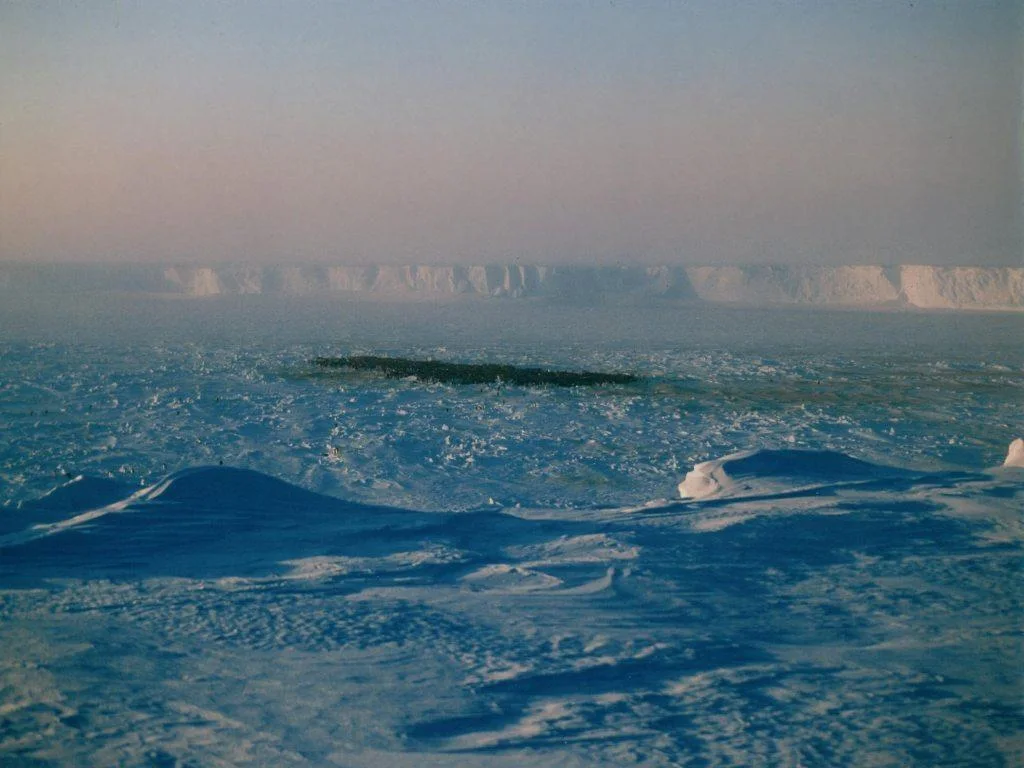
The attributed reference image has its own place and date recorded on the source page. It is not a newly reported colony visit, and a historical image should not be presented as a current assessment.
Describe behavior at the scale observed
A photograph may show individuals clustered together, adults beside chicks or animals spaced across ice. Those are observations of position and appearance. Inferring a social function, thermal benefit or sequence of behavior requires additional context, and usually more than one still image.
Even a clearly visible chick does not establish that it later fledged. Breeding success concerns an outcome over time, while a portrait records a stage. Keep those two questions separate when reading an account of a colony's condition.
A caption can make the evidence stronger
A useful caption gives the location and date when known, identifies the species and explains whether a count or behavior description comes from a formal survey. If it is an illustrative image, say so. Uncertainty is more informative than inventing a precise colony total.
For wider claims, read the underlying survey and ask how it dealt with viewing angle, image quality, seasonal timing and animals not present. This companion to our breeding-cycle explanation focuses on observation limits. It is not a field report, a survey result or an invitation to approach wildlife.
A count needs a defined population and moment
Before counting visible birds, decide what the proposed count represents. It might concern individuals within a frame, birds present at a site during an observation or a wider breeding population. Those are different targets. A precise count of visible shapes can still be an incomplete measure of the larger target if animals are hidden, outside the frame or elsewhere.
This is why survey design matters before arithmetic. Researchers define the area, timing and method needed for their question. A general photograph may not have been made for that purpose. It can illustrate a colony while remaining unsuitable for a complete count. The limitation comes from the observation's coverage, not merely from the reader's willingness to count carefully.
Start with the actual Halley image rather than an imaginary colony
The cover filename says Halley in 1999, but its source note qualifies the capture as approximately 1998 or 1999. Read that qualification rather than copying the filename as a precise date. This provides an immediate answer to a practical question: the image cannot independently describe the colony's condition in the article's revision year. Treat it as a historical visual record and preserve the uncertainty in its date.
For a counting exercise, label the result visible-frame count and mark uncertain shapes rather than announcing a colony total. The species profile explains the breeding context, but it does not supply a survey of the cover image. To discuss later population change, bring in dated observations designed for that comparison. This gives readers a specific distinction between appreciating the historical frame and evaluating a current conservation statement. The photograph is useful precisely when its time, coverage and role remain explicit, rather than being promoted into evidence for an outcome it did not measure.
Keep life stages attached to visible observations
Adults and chicks visible in a frame represent particular stages of a breeding cycle. A photograph can show that stage without revealing the eventual outcome. To assess breeding success, the study must define the outcome and observe or estimate it appropriately. A chick portrait should not silently become evidence that the bird later reached another stage.
The companion breeding article explains why the sequence matters biologically. Here the image-reading task is narrower: identify what the frame supports and what a later observation would need to establish. This prevents an emotionally powerful scene from carrying a conclusion outside its time boundary while still allowing it to illustrate the animal's life cycle.
A behavior description should not invent intention
Describe positions and visible actions before assigning social meanings. Close grouping, an adult beside a chick or a bird moving through a cluster can be observed. The reasons for those actions may require repeated observations and species research. Human emotions can make an appealing caption but should not be presented as measurements of what the animals felt.
Scientific context can still explain a known behavior when attributed to an appropriate source. The distinction is between using research to interpret a general pattern and claiming that a particular individual's internal state is visible in a still image. A careful caption can be engaging through specific observation rather than invented dialogue or a sentimental narrative.
A comparison through time needs matched evidence
For two colony images, check the site, season, date within the breeding cycle, viewpoint and visible area. If any differ, explain the effect on the comparison. A historical photograph and a recent photograph can be valuable records without independently establishing a population trend. The question is whether the observation process supports the proposed inference.
Look for a formal survey when the claim concerns abundance or change. Its methods should explain how images or other observations were converted into estimates and how uncertainty was handled. The public-facing article can summarize that reasoning in plain language. It should not replace it with an unqualified claim that one photograph obviously proves the colony increased or declined.
Use a two-column caption exercise
In the first column, list only what is visibly supported: species identification when established, visible life stages, grouping and the framed surroundings. In the second, list claims requiring other evidence, such as total abundance, reproductive outcome or a species-wide trend. Attach sources to the second column rather than allowing the photograph's emotional force to stand in for them.
This exercise gives a reader a useful way to handle wildlife imagery across news and education. The colony photograph becomes a record with boundaries and a starting point for questions. Its value does not depend on being a census. A strong image can help people notice the animals while a properly described survey answers the larger population question.
A visible count can still have a useful name
If an educational exercise counts birds within a photograph, call the result a visible-frame count and state the counting rule. Mark obscured or uncertain shapes separately. That modest label preserves a legitimate observation without promoting it to a colony estimate. It also gives students an opportunity to compare their uncertainty and discuss why a formal survey needs a defined method before producing a broader number.