Iceberg Shapes: Describe the Form Before Guessing Its History
A guide to the difference between an observable shape and an inferred origin.
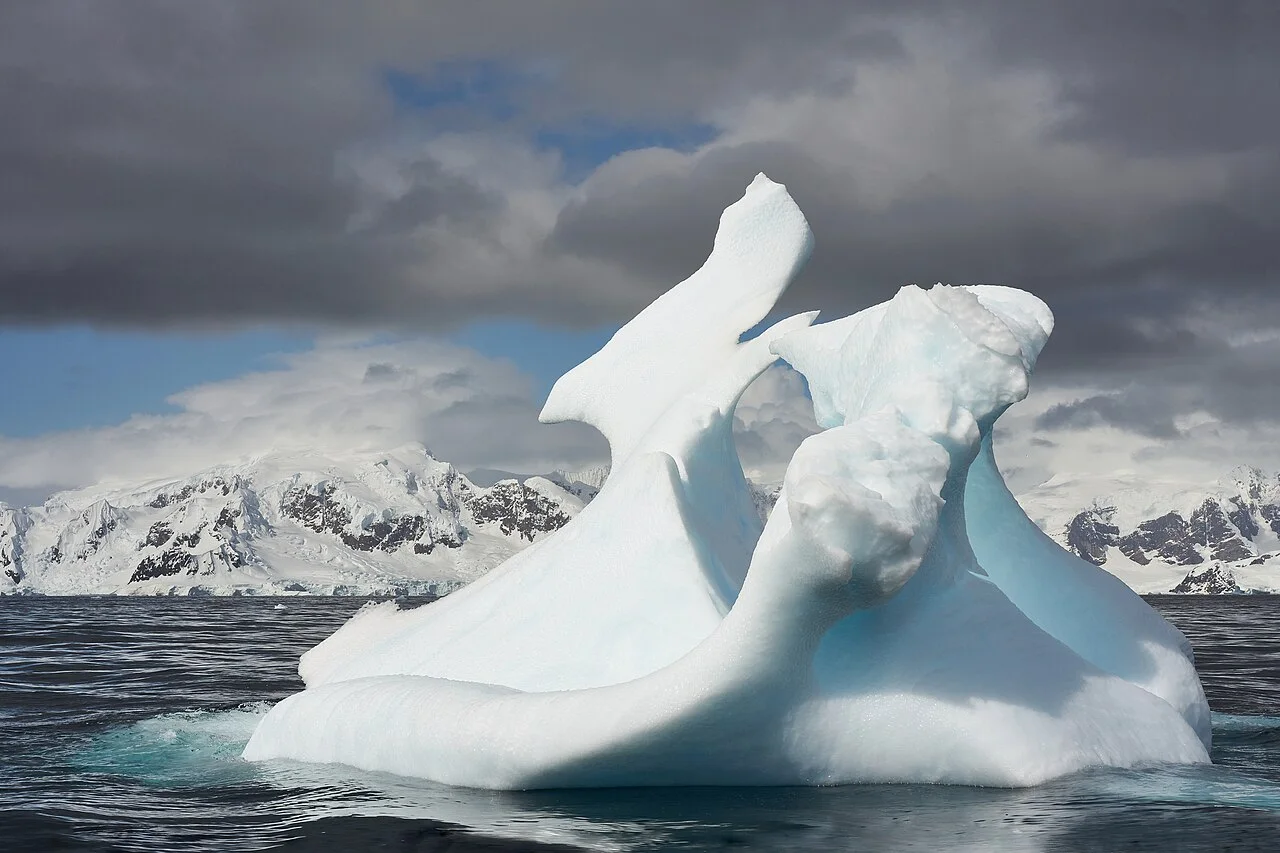
A shape is a useful description
An iceberg can have a flat top, steep faces, arches or irregular projections. Describing these features helps readers compare images, but a shape label does not provide the iceberg's complete history. Fracture, melting, erosion and changes in orientation can alter what is visible.
The scale matters too. A photograph without a reliable reference can make a small remnant appear monumental. The licensed image here illustrates a form; its source title and credit should be read before assigning it a size category.
Floating ice exposes only part of the object
The underwater shape is not fully visible in an ordinary surface photograph. A dramatic projection above the water does not establish the geometry below. Nor does a seemingly stable view prove that the iceberg will maintain its orientation.
An image is therefore not a safe-distance calculation or a guide to approaching ice. Vessel operations require current information and qualified judgment, and a reference photograph cannot provide either.
Origin and motion need additional evidence
To associate an iceberg with a named glacier or shelf, look for a documented calving event or a track connecting the observations. To estimate movement, use dated positions and an appropriate method. A blue band, a flat surface or a sculpted arch alone cannot establish a precise age or source.
NSIDC's glacier material explains how icebergs originate from land ice and why researchers study their evolution. This guide adds a visual-reading method: first record shape and scale, then separate any explanation of origin, movement or change into claims that need their own evidence.
Read the source title before assigning a size category
The credited photograph's title describes a growler and a sculptural form. Read that source information before assuming that a dramatic close view depicts an enormous iceberg. The title offers context, but a formal dimensional claim still needs measurements. A small object close to the camera and a much larger distant object can both fill an impressive portion of a frame.
NSIDC's glacier material supplies the broader origin of icebergs from land ice. It does not identify the exact parent glacier or age of this photographed remnant. For an observation note, separate visible form, available scale and documented origin. Mark the last two uncertain when the evidence is missing. This gives readers a concrete method for handling a visually striking image without inventing the object's biography, or treating a shape description as a prediction of stability or permission to approach floating ice.
Scale needs a trustworthy reference
A familiar object can help a viewer judge size only if its relationship to the iceberg is understood. An object much closer to the camera can appear deceptively large, and a distant ship can seem small for reasons unrelated to the iceberg's dimensions. Perspective must be considered before converting a visual impression into a measurement.
If a source provides measured dimensions, retain the method and date. If it does not, avoid inventing a size from a dramatic crop. A wide scene can still illustrate a substantial-looking form without assigning an unsupported height. The distinction is particularly important when different images are compared as evidence that one iceberg belongs to a larger category than another.
The waterline is a boundary in the image
An ordinary surface photograph shows a waterline and the portions visible above or through the water under those conditions. It does not reveal a complete underwater model. Reflection, water clarity and viewpoint affect what can be seen. A visible overhang or tower therefore cannot define the entire submerged shape or establish how the object will behave next.
This is why the image should not be used to calculate a safe approach or predict stability. The observational lesson is simpler: a partially visible object remains partially known. A diagram can explain that principle, but its underwater outline should be labeled conceptual unless supported by actual measurements. Otherwise the illustration can quietly replace uncertainty with an invented shape.
A form can have more than one contributing process
Fracture and subsequent changes can produce a complex visible object. A single arch or projection does not necessarily identify a unique sequence of events. When an article proposes a history, ask what observations connect the steps. A plausible mechanism is useful context, but it should not be presented as a documented biography of this particular iceberg without supporting evidence.
Compare the claim with its source. General glacier science can explain where icebergs come from and the processes that affect them. A specific origin claim needs a documented event or track. Keeping those levels separate allows a source-backed explanation without pretending that a textbook mechanism independently identifies the exact glacier or departure date of every photographed object.
Repeated images need reliable identification
To study change, establish that the images show the same iceberg and identify their dates and viewpoints. Rotation can alter the visible silhouette, so a different outline need not mean that the same visible face simply melted away. A useful sequence considers orientation as well as changes to the object. Gaps between images should remain visible in the account.
For an illustrative exercise, rotate an irregular model and compare its outlines from one camera position. The shape in the frame changes without altering the model itself. This demonstration explains a geometric possibility, not the history of a real iceberg. Actual interpretation still needs the observation sequence and environmental information appropriate to the question being investigated.
Write the observation before the story
A concise record can list visible form, available scale, source date, viewpoint and any documented identity. Put proposed origin, motion and change in a separate part of the note, with supporting evidence. If the evidence is missing, leave those questions open. That is more informative than assigning a precise age because a surface looks unusually blue or weathered.
The result is a visual-reading method that readers can reuse with dramatic iceberg imagery. The form becomes something to examine carefully rather than a shortcut to a complete environmental story. A photograph can invite attention to glacier processes while its caption preserves what is known, what is inferred and what additional observations would be needed to connect the two.
An illustrative diagram needs an explicit label
If a diagram supplies an underwater outline merely to explain partial visibility, identify it as conceptual. Do not let a plausible-looking drawing become an apparent survey of the photographed iceberg. A measured model would need its own source and method. Keeping that distinction visible preserves the diagram's teaching value without inventing geometry that the surface image cannot establish.
An object's documented appearance belongs to the observation date, even when the article is revised later.