Look Below the Flowers: Reading an Arctic Tundra Scene
A flowering landscape contains more than a brief display of color.
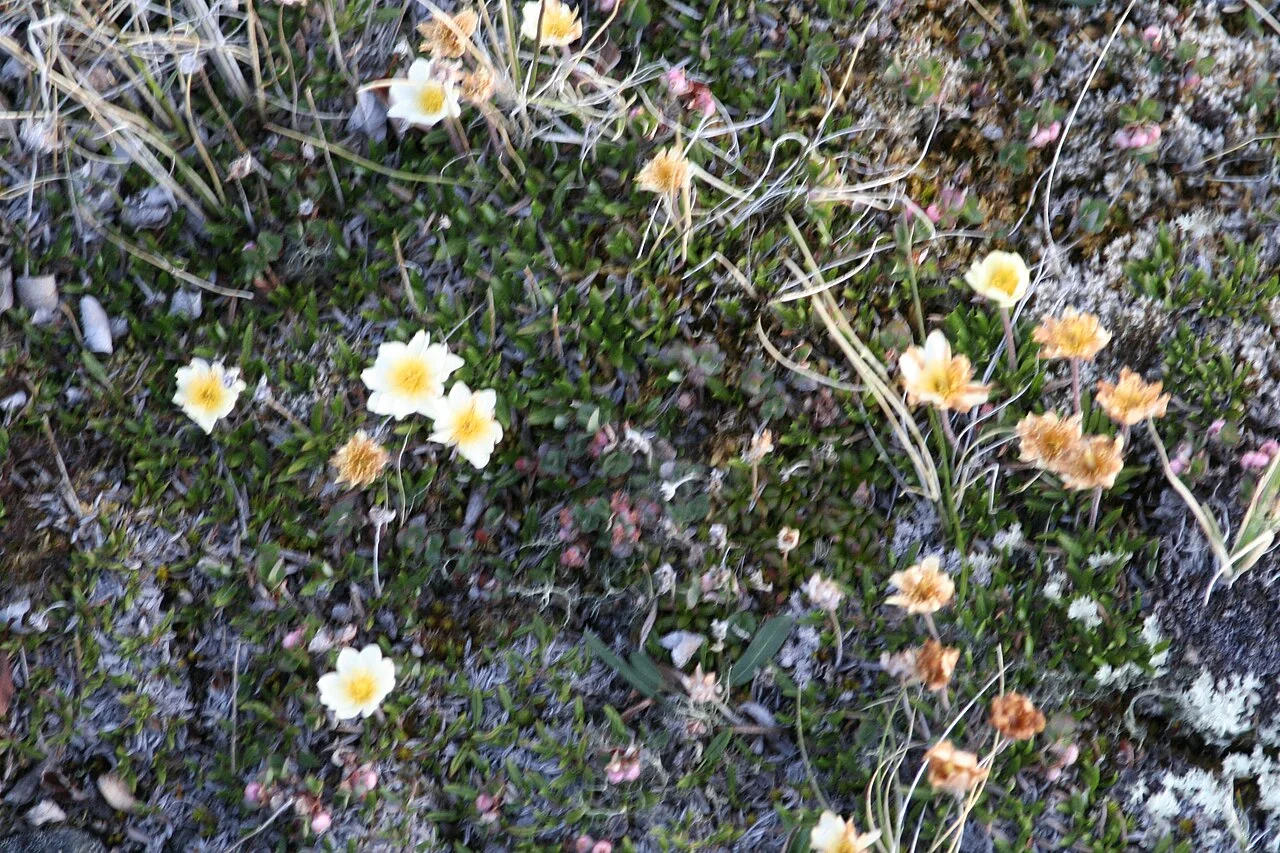
The foreground is a plant community
An Arctic summer photograph may show flowers, sedges, low shrubs, mosses and lichens. These are not interchangeable decorations. Their forms and distribution can reflect different responses to moisture, exposure and the ground beneath them.
The National Park Service's account of Arctic tundra describes a low-growing landscape with sedges, shrubs and an organic ground layer. Looking for those components is more informative than reducing the scene to a claim that every tundra has exactly two weeks of summer.
A flowering date is local evidence
Flowering depends on species and local conditions. A dated image can document a plant in flower at that place; it cannot establish the growing-season length of the entire Arctic. Comparing years requires compatible observations of the same phenomenon, not simply finding two colorful photographs.
A change in color can also reflect the species in view, the stage of growth or the photographic process. A landscape image should not be turned into a climate trend without a suitable repeated record.
Small features deserve careful observation
Notice whether vegetation occupies hummocks, wetter ground or more exposed patches. Record visible differences without assuming that a camera can diagnose soil temperature or carbon exchange. Ground measurements and research methods answer those questions.
The credited reference photograph is not a Polar Nature field collection. It supports an invitation to look carefully, not to pick plants or leave established routes. Local protection rules matter, and trampling a small community for a close-up can damage the subject being admired. A useful observation preserves both the record and the place.
Read the landscape at more than one height
Begin with the foreground plants, then look at how their cover changes across the scene. Low shrubs, sedges and other ground-layer components occupy a landscape that can vary over short distances. A wide photograph may show a pattern without resolving individual species. Do not turn a broad vegetation description into a precise species list unless identification is actually supported.
A close-up and a wider view can complement each other when their locations and dates are known. The close-up may show a flower clearly, while the wider image provides setting. Neither automatically describes the entire community. Keeping their roles separate helps readers notice the landscape's structure rather than treating all low vegetation as the same colorful surface.
A flower records a stage, not an entire season
A dated image of a flowering plant establishes an observation at a particular place and stage. It does not directly mark the start or end of the growing season. Different species and local settings need not share one flowering timetable. A claim about seasonal duration therefore requires an appropriate definition and repeated observations rather than a single attractive date.
For a useful educational comparison, ask whether two records concern the same species, site and life-stage definition. If not, state the mismatch. An early photograph of one species and a later photograph of another cannot independently establish that flowering shifted between years. The visual record becomes more valuable when identification and timing are kept together.
Color change has several possible explanations
The dominant color in a frame can change with plant composition, growth stage, illumination and camera processing. A greener-looking image is not automatically a measured increase in vegetation productivity. Before making a trend claim, identify the variable and method used by the underlying research. Ordinary scenic photographs and standardized observation products answer different questions.
This does not make photographs irrelevant to environmental history. Repeated images can contribute when their design and context support the comparison. The important step is to explain that method. A reader should be able to tell whether the article is describing appearance, documenting a local event or summarizing a measured ecological trend rather than sliding between those purposes within the same paragraph.
Small topographic differences can organize the view
Look for visible patches on raised ground, wetter-looking areas and more exposed surfaces. Describe their arrangement without diagnosing every underlying cause from the image alone. The NPS tundra account provides ecological context for the landscape, while measurements are needed for claims about soil temperature, water conditions or carbon exchange at a particular site.
An annotated photograph can use cautious labels such as raised patch or visible standing water when supported. Avoid assigning a complete soil profile or permafrost condition based on surface appearance. This way of looking connects plants to their setting while respecting the boundary between a visible pattern and an explanation that requires additional field evidence.
A repeated observation needs a consistent question
Imagine a fictional monitoring project recording the first open flower of one identified species at a defined site. Its result differs from a casual note that flowers were present during a visit. Both are observations, but only the first has the stated design needed for that specific timing comparison. Keep the observation rule with the reported date.
The same principle applies to cover estimates or community change. Decide what is being observed, where and how often before interpreting differences. A missing visit can leave a timing uncertainty rather than proving that an event did not occur. These details explain why a modest, consistent record can answer a question that a collection of spectacular but unrelated photographs cannot.
Compare the cover's location with NPS's ecological example
The cover source identifies tundra flowers near Pangnirtung. NPS's Arctic tundra article illustrates another specific setting: flowering tussock cottongrass in Noatak National Preserve one year after fire. These are not two frames of the same monitoring site. Putting them side by side can teach differences in setting, but cannot establish a flowering-date trend or make the post-fire context apply to the Pangnirtung image.
For a useful comparison, label location, known date, community description and disturbance context separately. Use broader plant descriptions when the image does not support reliable species identification. Then ask which repeated observation would test the proposed change. The NPS example shows why ecological context matters: an attractive flowering scene can also belong to a disturbance history. The practical outcome is careful local interpretation, rather than treating every colorful tundra image as evidence of an identical short summer or a uniform Arctic response.
A careful identification can remain provisional
If an image lacks the features needed for reliable species identification, use an appropriately broader description and record the uncertainty. A confident name is not automatically a better observation. Retaining a provisional identification can help a specialist assess the record later, while an unsupported exact name may create false precision in any comparison of flowering dates or distributions.
A missing observation date is a gap in coverage, not proof that the plant was not flowering.