Why Auroras Glow Green, Red and Purple
Follow the chain from the solar wind to atmospheric light, without confusing an aurora with reflected sunlight or a local weather forecast.
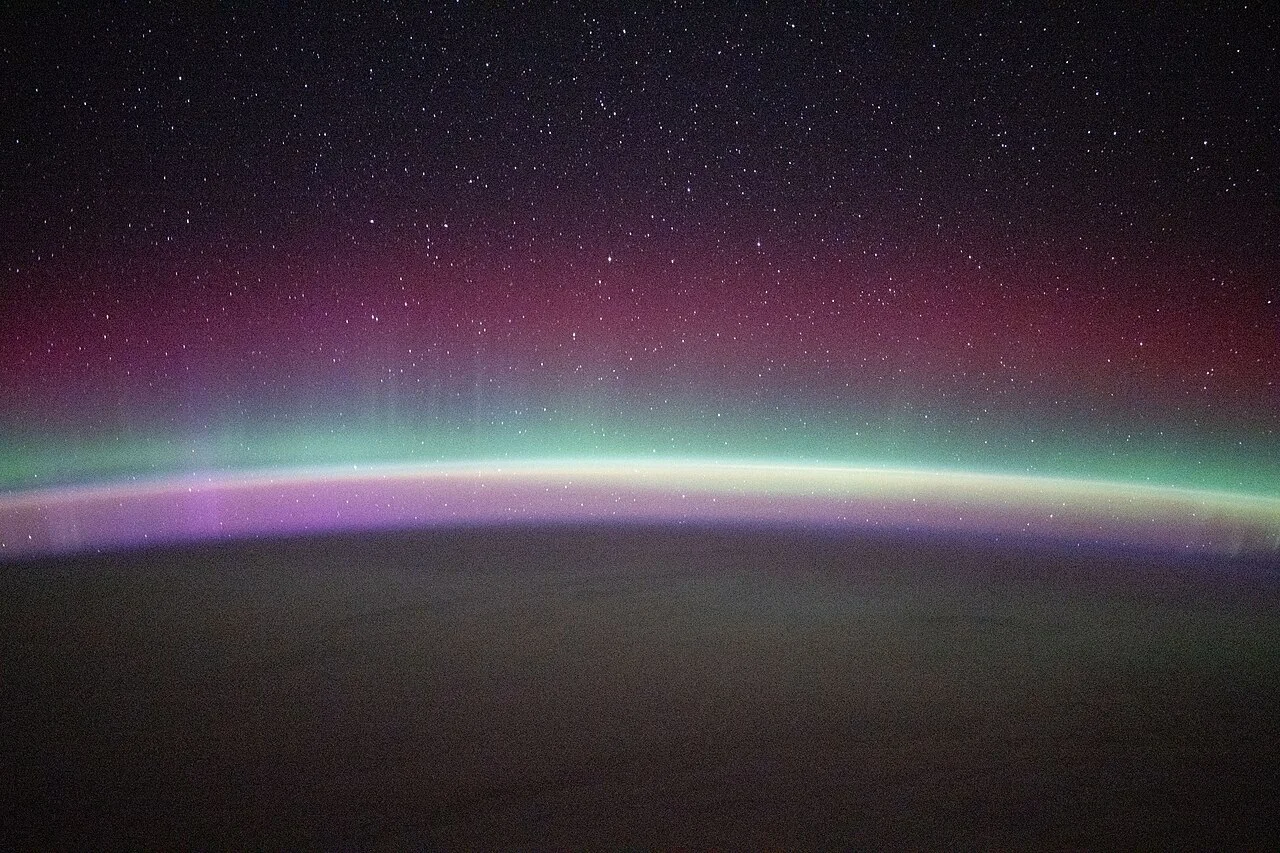
An electric connection, not sunlight on ice
An aurora is light emitted in the upper atmosphere after energetic particles transfer energy to atmospheric gases. The solar wind helps disturb Earth's magnetic environment; acceleration within that environment can send electrons along magnetic field lines toward the atmosphere. It is misleading to picture every bright curtain as a stream of solar particles flying straight from the Sun onto the ground.
The useful sequence is energy transfer, particle acceleration, collision and light emission. An excited atom or molecule can release energy as a photon. Different gases and different transitions release different wavelengths. That is why an aurora's color contains physical information, even though a photograph alone is not a complete atmospheric measurement.
Why oxygen does not make just one color
NASA explains that oxygen is associated with familiar green light and with red emissions higher in the atmosphere; nitrogen contributes blue and purple tones. The result depends on the emitting species and on conditions at the altitude where the collisions occur. A bright lower edge and a diffuse red upper glow need not indicate two unrelated events.
A kitchen-light analogy is useful only up to a point: different emitters have different spectral signatures, but the atmosphere is not a set of colored lamps wired to a single switch. Particle energies, density and the time available for an excited state to emit all affect what appears. A color chart is therefore a starting explanation, not a way to infer exact altitude or energy from an uncalibrated image.
What a camera changes
A long exposure accumulates light that a person's eyes may perceive as faint or nearly colorless. White balance, sensor sensitivity and editing can change the displayed colors again. A vivid photograph is not proof that everyone at the site saw the same saturation. A responsible caption separates the physical phenomenon from the recording choices.
Similarly, a forecast of geomagnetic activity is not a promise of visibility. Clouds, twilight, light pollution and the viewing direction can prevent an observer from seeing an aurora. For planning an observation, consult the official forecast and local sky conditions rather than treating the brightness of another person's photograph as a forecast for your location.
A simple way to read the next aurora image
Ask three separate questions: what gas emission might explain the color, what magnetic structure might organize the curtain, and what camera settings shaped the record? Answering only the first leaves out much of the image. This separation also explains why the science article and our aurora observation guide serve different purposes: this page explains how light is produced; the companion guide concerns interpreting an observation and its metadata.
Use NASA's explanation to reject the reflection shortcut
NASA Space Place describes the Sun, Earth's magnetic field and atmospheric interactions in its aurora explanation. Follow that sequence rather than drawing a direct beam from snowy ground into the sky. The Sun supplies energy to the wider process, but the visible glow is produced in the atmosphere. That distinction answers why calling aurora reflected sunlight gives the wrong mechanism even though solar activity matters.
Use the conceptual chain beside the photograph and name what each step contributes. A green-looking curtain illustrates emitted light; the image does not independently measure particle energy or identify every atmospheric condition. For a color question, return to the emitting constituent and transition. For whether an observer can see it, add darkness, cloud and location from viewing guidance. Separating production from visibility makes the physics useful without turning a beautiful image into a local forecast or a direct measurement of every link in the chain.
Why a curtain can look structured and still move
Earth's magnetic field helps organize the paths along which particles reach the atmosphere. Many nearby emitting regions can therefore form rays and folds rather than a uniform glow. From the ground, perspective can make these structures resemble curtains or an overhead crown. Their apparent shape depends partly on where the observer stands relative to the emitting region, just as a row of tall posts looks different from its end and from its side.
The analogy concerns perspective only; it does not supply an atmospheric scale or explain every motion. Changes in the energy entering the system and in the processes accelerating particles can alter the display. A still photograph records one exposure interval within that evolution. It cannot establish a complete movement sequence. For that, a timed series or video with known settings is more informative than a single dramatic frame.
Three claims to check before sharing an image
First, check whether the caption distinguishes observation from processing. A photograph can truthfully depict an aurora while using a long exposure and a strong color adjustment. The responsible description tells readers what was recorded and what was changed. Second, check the location and date. A genuine image from an earlier event is not evidence that the same display occurred tonight at a different place.
Third, examine the forecast claim. A broad geomagnetic index summarizes activity; it is not a weather forecast for the cloud above one town. Visibility also requires darkness and an appropriate view. A high activity value can coexist with an invisible display behind clouds, while an observer well placed beneath an auroral region can see something during less dramatic overall activity. The useful decision is to combine the official space-weather information with local observing conditions.
What an explanation should leave you able to do
After reading an aurora story, you should be able to separate its physical claim from its photographic and forecasting claims. Ask whether a color explanation names the gas involved, whether a brightness comparison accounts for exposure and whether a viewing promise considers cloud and daylight. These questions do not require you to become a space physicist; they help you avoid accepting an attractive picture as evidence for unrelated conclusions.
For deeper study, follow the linked NASA explanation for the color mechanism and NOAA's account for the magnetic and observing context. Treat them as complementary entry points rather than scripts to paraphrase. This page's contribution is the connection among mechanism, image and decision: the same display can be physically interesting, photographically vivid and still unsuitable as a promise of what a particular traveler will see.
One final distinction: seeing and measuring
A visual observation can be valuable without being a calibrated measurement. Describe what you saw, preserve the circumstances and avoid assigning precision the record cannot support. This makes an ordinary observation more useful to another reader and leaves room for instruments to answer the questions that eyes and an edited photograph cannot.